

Graduate Student Assistant, Department of Digital Stewardship, Syracuse University
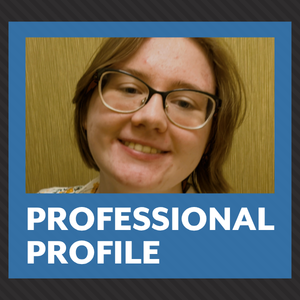
Tell us a bit about yourself. Where are you from, and what did you study? Where are you currently based?
I’m from Philadelphia originally, but I went to college in the Susquehanna Valley. I attended Susquehanna University for undergrad, where I studied creative writing, publishing, and civic writing. I’m currently based in Syracuse, New York, where I’m studying for my Master’s in Library Science!
I’m incredibly interested in the ways publishing and librarianship intersect. My favorite things to research are open access, piracy, scholarly communications, copyright, library publishing, and the intersections between information and entertainment.
Describe your current role and organization. What are your main responsibilities? What type of organization do you work for?
My full title is “Graduate Student Assistant – Department of Digital Stewardship,” but I’ll usually tell folks that I’m an open access graduate assistant, since I work exclusively with open access. I work for Syracuse University through its Bird Library. SU is a large private research university, so I’m working almost exclusively with academic output written by faculty.
I’m responsible for one large project with some smaller jobs peppered in between. I spend most of my time writing metadata and uploading content for my library’s institutional repository. My main project is to digitize and publish materials from the university’s social justice center. I’ve also found myself conducting checks on open access licenses, gathering information about current author publishing agreements, and writing HTML for some smaller projects I’ve been given.
Walk us through a typical day in your role. What challenges do you face? What opportunities do you encounter?
Since I’m a student worker, I’m only allowed to work a twenty-hour workweek. I split this into five-hour work sessions, four days a week. I typically spend my mornings at work and my evenings in my library science classes. It doesn’t sound like much, but I’m usually out of my apartment for ten, eleven, or twelve hours at a time.
I can work anywhere my laptop is, but I prefer working at my cubicle. I usually spend my shifts plugging away at spreadsheets on my laptop. Recently, I’ve been gathering metadata from a massive 100-page bibliography and sorting it into our library’s standard MAP. This involves writing ORCID numbers in HTML, confirming CC licenses, and double-checking every piece of information for correctness and standard formatting. This illustrates my day-to-day work very accurately.
The biggest opportunity is being able to work with a real institutional repository on actual work. When I graduate, I will be able to point to a website and say, “I published this.” That is an incredible thing to have on my resume, and it’s work I’m incredibly grateful for. The biggest challenge is mostly in the realm of communication – other departments sometimes don’t match what we’re looking for in our repository. I think that’s why general education on what open access is is incredibly important in academic institutions.
Share your journey in scholarly publishing. What was your first role in this field, and how did you land it? What path led you to your current position? What unexpected challenges have you faced?
This is my first real role in scholarly publishing, but I’ve been studying and working in libraries for a few years now! In my undergraduate I was given a March Fellowship for Ethical Leadership, which allowed me and the director of Susquehanna’s library the funding to conduct research on campus. We studied textbook piracy on campus and found that piracy is caused by inaccessible and unaffordable textbooks. We presented this research at a few conferences, namely the Pennsylvania Library Association Conference in the fall of 2023. This was my first venture into research, and I absolutely fell in love with it. Since then, I completed a few other open access projects with Susquehanna, published a chapter on library accessibility for neurodiverse students, and applied for my MLIS program. The rest is history!
Can you share a memorable project, achievement, or pivotal moment in your career development? Was there a defining moment or influential person who shaped your career?
Since I’m still extremely new to the field, every achievement and every step forward feels pivotal. Getting a Fellowship with SSP, receiving my graduate assistantship, and attending library conferences as an undergraduate have all been so influential in my early career. (Special thanks to Susquehanna University’s library – I wouldn’t be here without you all!)
What future trends do you foresee in the field of scholarly publishing?
AI is the massive elephant in the room; so massive that the proverbial trunk is sticking out one door and the tail is coming out the other. To speak anecdotally, many of the authors I’ve spoken to are reluctant to use open publishing methods because of the fear that their work will be absorbed and stolen by AI training models. They’re absolutely right to worry about this – internet crawlers and data scraping is a problem of epic proportions. However, any information on the internet can be used to feed AI, open access or not, and I believe that an almost fear-mongering attitude shift has occurred towards forms of scholarly publishing. I believe that the evolution of the library publishing industry will ultimately shift with the attitudes towards AI.
Beyond AI, I think that the ever-present shift towards digitization will continue. Physical copies of open access texts are exceedingly rare, with digital repositories and websites seemingly reigning supreme. Given the increasing costs of book production and the internet’s ability to make an article incredibly discoverable, I think that scholarly communications will be a predominantly digital field. However, if fears about AI continue to fester, I suspect that there may be a shift away from open access and repository sites as a whole, for fear of AI scraping. I hypothesize that authors may begin to shift towards paywalled (digital) and traditional means of publishing (physical books) under the guise that this will make it more difficult for AI to access the materials.
What motivates you in your work? What keeps you passionate about your role in scholarly publishing?
I deeply, deeply value the spread of free and accessible information. I’ve seen people have to choose between their textbooks and meals. I’ve seen my peers pass around textbooks in an underground network, because otherwise nobody would be able to afford the homework. I want to work in academic libraries. What I don’t want is to watch these cycles of closed information persist. Open access is all about making public information, and that’s enough to keep the passion alive.
How do you balance your professional and personal life? Any fun facts or hobbies outside of scholarly communications?
I’m a graduate student, so work-life balance isn’t part of the job description. I use my mornings, evenings, and at least one day over the weekend for myself and myself only. I think my current setup actually works really well; I never feel too overwhelmed for long, and I always have time to work on my hobbies for at least a little while.
Outside of my work, I write short fiction! I’ve published two micro short story collections under a pen name, and I’m currently building up to a third! I also enjoy linocut printmaking, reading, and gaming.

