
Scholarly publishing professionals convened in Washington, DC, as they do each fall, for our New Directions Seminar on October 7-8. This year’s event was titled “Show Me the Incentive, and I’ll Show You the Outcome.” Attendees, including those who joined virtually, enjoyed insightful talks, panels, and roundtable discussions. Those who could attend in person also benefited from personal interactions during breaks, a happy hour, and group dinners.
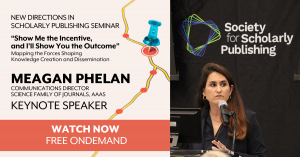
The event began with keynote speaker Meagan Phelan, Communications Director for the Science Family of Journals at AAAS, who addressed the group on how journals can instill confidence in the public during a time when an atmosphere of doubt against science has taken hold. As an example of how to approach building confidence, Ms. Phelan explained how Science brought together authors of papers with seemingly conflicting results for a press conference. They discussed how the results of the two papers were complementary and inspired additional study. Ms. Phelan also explained how AAAS is using “Policy Paks” to reach policymakers on all sides of the political spectrum, resulting in more news coverage in policy outlets. Watch the keynote for free!
Attendees participated in a roundtable discussion led by a moderator to share opinions on topics related to transparency, academic work credit, such as peer reviewing, and the impact of technology on our field. Tables gathered again at the end of the day to reflect on how the talks had influenced or changed their opinions.
In “Transparency in Research to Support Credibility and Trust,” colleagues learned about tools and processes being developed to increase transparency. One process was designed to streamline the collection and sharing of conflict of interest information for articles. Another speaker explained how to include data in accordance with CARE Principles, specifically regarding how data was collected from Indigenous communities. They also heard about a new tool, Figure2, that allows authors to create figures from original data that is stored and linked to the figure. All of these aim to allow authors and publishers to more easily convey information transparently, improving the credibility and trust of research.
Next, the group heard from a panel of experts, including a researcher and a librarian, who discussed peer review and how reviewers can be incentivized to donate their time and effort as scholarly publishing continues to change. Researchers review for various reasons, which differ depending on factors such as field and career stage. Reviewing remains a part of the promotion and tenure process, allowing reviewers to get a sneak peek at the latest research. The panel discussed the pros and cons of additional compensation, from financial to credits for society dues or meeting registration. Of course, the panel discussed how AI might affect the review process, from helping authors polish their articles and identifying potential reviewers to conducting an initial or even robust review, as well as the ethical implications of all of the above.
The Accessibility Coffee Talk stressed the importance of publishing content that is accessible for all people, since 15% of the world’s working-age population has some form of disability. Not only is it the right thing to do, but there are business benefits: it creates a better user experience, improves discoverability, and in some cases, it is the law! It is essential to create born-accessible content, as it is easier to do up front rather than having to modify previously published material.
In “A Fighting Chance: Funding and Support Strategies for the Current Moment,” panelists from Open Access organizations and societies discussed different publishing business models and how open infrastructure can be maintained and improved at a time when funding is harder to come by.
Although AI was a frequent topic throughout the webinar, a panel of consultants and vendor representatives on the front lines of the AI revolution spoke directly about “AI as Reader, Author, and Reviewer: Risks, Rewards, and Real-World Use.” The discussion covered the challenges and opportunities of AI use, either to create or to review content; the implications of content being added to LLMs; the ethics and effectiveness of requiring and enforcing disclosure of AI use; the environmental impacts of AI; potential effects on the workforce; and preserving what makes research human.
Finally, a panel representing data analytics companies, publishers, and consultants tackled the topic “From Impact Factor to Impact Framework: Transforming How We Evaluate Research.” The group addressed the pros and cons of the existing metrics, including the Journal Impact Factor, potential alternatives that would instill credibility and trust, approaches to transparency and accountability, and why the status quo in academia has been so resistant to change.
The SSP staff, New Directions organizing committee, speakers, and sponsors all pitched in to create a thoughtful and rewarding opportunity for those who care about scholarly publishing to connect and learn from one another. View photos from this event.
News contribution by SSP member John Long. John is the Director of Publications for the Biophysical Society.

