

Independent Consultant; SSP Board Member-at-Large
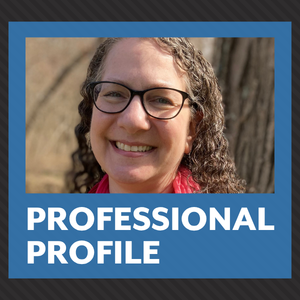
Tell us a bit about yourself. Where are you from, and what did you study? Where are you currently based?
I grew up in the Blue Ridge Mountains of southwestern Virginia, and I went to college in St. Louis, but I’ve been living in Washington, DC, for longer than I’ve lived anywhere else. I selected my university (Washington University in St. Louis) for its geology program, but between graduating from high school and actually getting to college, I decided to switch my major from geology to theatre. (Weird detour, I know.) I got a degree in technical theatre, specializing in stage management and lighting, and after graduation, I started working as a scenic artist in an industrial sign shop. I was painting giant pieces for things like trade shows, and for the first time, I was up close and personal with letterforms. I didn’t even know the word “typography,” but I was fascinated—why did this “s” have this little thing sticking off of it (I also didn’t know the word “serif”), but this “c” didn’t? I ended up going back to school and getting a second degree in graphic design. It was there that I learned there are people who just design publications, and that’s when everything clicked. After finishing that degree, I worked for a while for a large international architecture firm and then went to my first scholarly publishing job, designing medical textbooks for Mosby-Yearbook, a name that I imagine will be a blast from the past for some people reading this. That’s when scholarly publishing became my happy place, and I’ve never looked back.
Describe your current role and organization. What are your main responsibilities? What type of organization do you work for?
I run a consultancy that handles both ethics and art direction for the scholarly publishing space.
Walk us through a typical day in your role. What challenges do you face? What opportunities do you encounter?
I don’t have a typical day! I love working with a variety of clients on a variety of kinds of projects. The ethics side is maybe the most intellectually rewarding, and the design/art direction side lets me stretch my creative muscles in a very different way. The combination delights me.
Share your journey in scholarly publishing. What was your first role in this field, and how did you land it? What path led you to your current position? What unexpected challenges have you faced?
As I mentioned, my first role in scholarly publishing was as a medical textbook designer for Mosby. The art director I reported to in that role had been my thesis advisor, and he was one of the most important mentors in my career. He has sadly since passed away, but he was an important part of my life for a long time. After Mosby, I worked in a number of roles, always in scholarly publishing, and eventually ended up at the journal Science, serving as the art director. As part of my job there, I investigated potential image manipulation in research figures, which was my entryway into ethics. I later expanded into ethics as a whole, beyond just image-based cases. One of the biggest challenges with ethics is not to jump to conclusions. It’s not uncommon for a case to seem to be straightforward, only for it to turn out to be anything but. Keeping an open mind is crucial.
Can you share a memorable project, achievement, or pivotal moment in your career development? Was there a defining moment or influential person who shaped your career?
On the art direction side, I’m proud of having been able to use my platform at Science to highlight significant research. I was responsible for selecting the cover for each week’s issue, and I was aware that there was often a correlation between a lab getting a cover and that same lab getting increased funding. There were times I would specifically choose research that might have gone underfunded despite being extremely worthy, and I’m endlessly happy to have been able to do so.
On the ethics side, I can’t go into detail due to confidentiality concerns, but I am proud of working to correct the scholarly record while always striving to treat everyone involved with dignity. People who are the focus of ethics cases are often at a low point in their careers, but that doesn’t mean they don’t deserve respect and empathy.
What tools, websites, and organizations are essential for your career growth? How do you stay updated with industry trends and developments?
I read a lot and connect with colleagues to stay apprised of what’s going on in our industry. And without question, SSP has been the most essential organization for my career growth. I can’t imagine my career without it. It is a foundation of my professional life… and also my personal life. I have so many dear friends who I wouldn’t know without SSP.
In your experience, what skills or qualities are essential for success in scholarly communications?
Curiosity! I think we’re all in this space because we love knowledge and love to share knowledge. Let’s keep the curiosity going.
What do you wish you knew more about in your field?
Everything! I hope I never want to stop learning and growing.
What future trends do you foresee in the field of scholarly publishing?
Is anybody NOT thinking it’s AI? But I’ll be honest, AI makes me deeply nervous, on multiple levels. The threats to copyrighted material, the threats to individual thinking and creativity, and just exercising your brain, the environmental threats, the list goes on.
What motivates you in your work? What keeps you passionate about your role in scholarly publishing?
Sharing knowledge in ways that are inviting and honorable, and hopefully serving as something of a role model for earlier-career colleagues.
How do you balance your professional and personal life? Any fun facts or hobbies outside of scholarly communications?
I have a sign that hangs in my office that reads, “Work hard and be nice,” and that’s really it in a nutshell. When I’m not working, I spend a lot of time with loved ones, and that nourishes me. I also never met a hiking trail I didn’t like, and I love live music, everything from ear-splitting rock to classical. And a fun fact about me is that my superpower is being able to pick the perfect-sized Tupperware for leftovers. It’s ridiculously satisfying.
What advice would you give to aspiring professionals in scholarly communications?
Don’t be afraid to connect with anyone in our community! We’re an extremely welcoming and supportive group, and we love to see one another succeed. J

